


Book Review: 'Swami Vivekananda - His Life & Legacy'

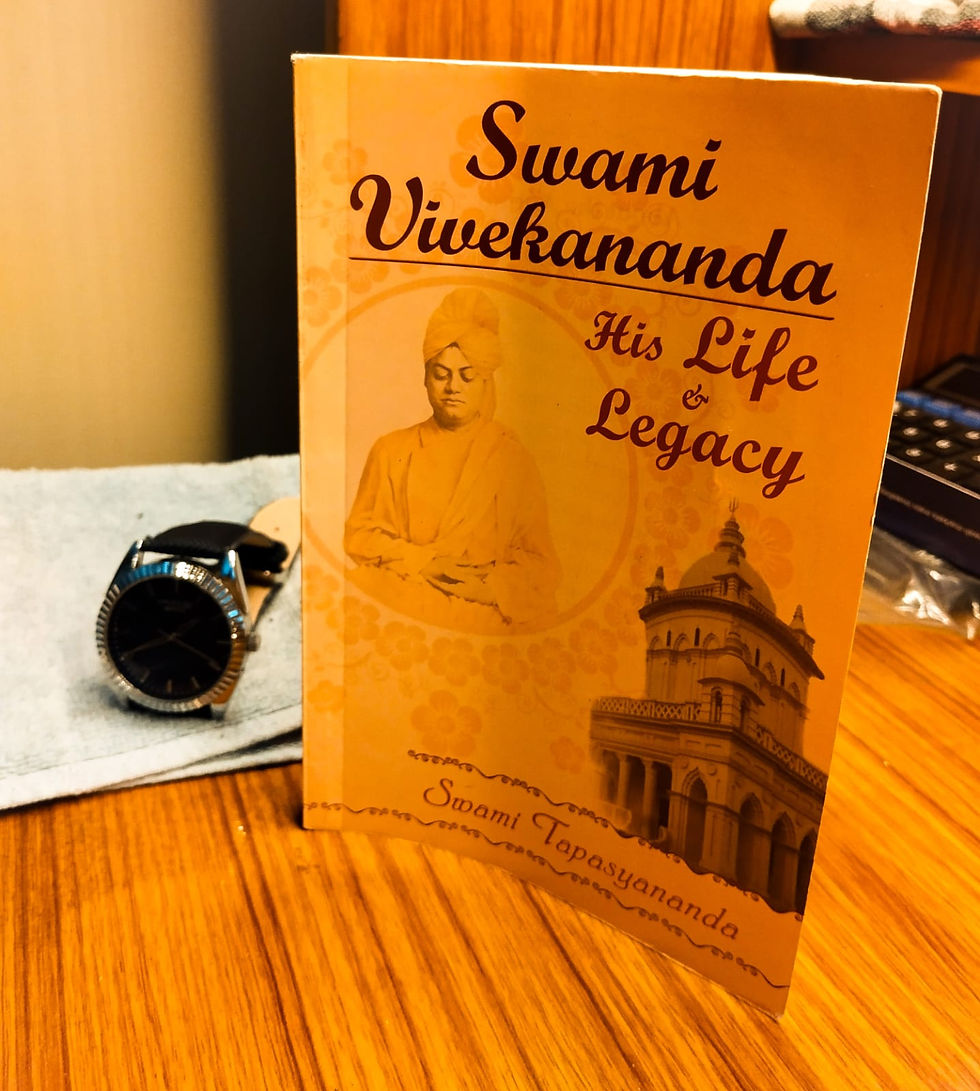
The name of Swami Vivekananda continues to grow in recognition and reverence across the world. And yet, even today, a great many people know surprisingly little about who he truly was, what he stood for and what he contributed — both to India and to humanity at large. Some admire him whole-heartedly, others misunderstand him and some unfortunately misrepresent him. This book, written by Swami Tapasyananda — a scholar-monk and one of the vice-presidents of the Ramakrishna Order — attempts to answer these questions. Through a vivid biographical sketch and a thoughtful analysis of Swami Vivekananda's legacy, this book offers the reader a well-rounded and deeply insightful portrait of one of India's greatest monks.
The Man Behind the Monk
Narendranath Datta was born on 12 January 1863 into the well-known Datta family of Calcutta, now Kolkata. His great-grandfather, Rammohan Datta, was a successful lawyer in the city. His grandfather Durgaprasad later chose the spiritual path, leaving his son Viswanath to carry the family forward. Viswanath — Narendra's father — was a remarkably generous man with a deep love for music and poetry. His mother, Bhuvaneswari Devi, was a woman of profound faith. It is said that since the family had no male child for some time, she prayed earnestly to Lord Vireswara (Shiva) of Kasi and Narendranath was born as the blessing of that prayer.
Even as a young boy, Narendra displayed an exceptionally generous nature. However, he also had a quick temper and his mother would calm him by pouring cold water over his head and having him chant the name of Shiva. Those who knew him closely also saw, even in his youth, the early signs of a soul that would eventually renounce all worldly attachment. His disciples later described him as an ascetic who had truly seen that reality holds nothing precious in the glitter of wealth or desire — such things, to him, were no more than dust and ashes.
There were difficult days during his early years when the family faced financial strain. On some mornings, realising that there was little food left at home, Narendra would quietly tell his mother that he had been invited somewhere and would be eating out — just so the remaining food could go to others in the family. Some days he ate very little. Some days he fasted entirely. And he never spoke of it to anyone outside the home.
Transformed by the Master's Touch
The chapter titled 'The Life' in this book offers a deeply moving account of Narendra's transformation under Sri Ramakrishna. As a follower of the Brahmo Samaj, Narendra was at the time a firm believer in a dualistic form of monotheism and was resistant to the Advaitic philosophy — the idea that all existence is one. Sri Ramakrishna, who knew that Narendra was destined to carry Advaitic thought to the modern world, resolved this through his extraordinary spiritual power. In one of their conversations, the Master touched Narendra — and what followed was nothing short of a revolution. As Narendra himself described it:
There was a complete revolution in the state of my mind in a moment at the wonderful touch of the Master. I was aghast to see actually that there was nothing in the whole universe except God. But I remained silent in spite of seeing it, wondering how long that state would last. But that inebriation did not at all diminish that day. I returned home, it was all the same there. It seemed to me that all I was, was He...
After returning from a pilgrimage to Amarnath, he fell into a deep and consuming mood of Mother-worship — something he himself felt like a 'malady of thought', leaving him no room for sleep or rest. On the night of 2nd September, alone in a solitary spot on his houseboat, he experienced a powerful vision of the Mother — much like the one he had known at Dakshineswar. This experience of mother Kali, was one of profound exaltation and he captured it in a short poem, 'Kali the Mother'.
A Message of Strength and Courage
Throughout this book, one theme rings out with remarkable clarity — Swami Vivekananda's call for strength. He wanted people to be physically healthy, mentally bold and spiritually fearless.
In one of his most powerful teachings on weakness, he said:
It is weakness, says the Vedanta, which is the cause of suffering. We become miserable because we are weak. We lie, steal and commit other crimes, because we are weak. We suffer because we are weak. We die because we are weak. When there is nothing to weaken us, there is no death or sorrow.
Swamiji himself lived this message. He travelled across the globe, walking for days without food, tired and footsore, yet never once giving up. There were stretches when he went without a meal for days together. In circumstances that would have broken most people, he carried on — with humility, patience and unwavering courage.
His sermons spoke equally of holiness and of bravery, of spiritual purity and of strong nerves. The book is filled with such sayings and any reader is likely to come away genuinely motivated to face life's challenges with far greater resolve.
Speaking to the World — Chicago, 1893
One of the most memorable moments in Swami Vivekananda's life was his address at the World's Parliament of Religions in Chicago, in September 1893. In a prayer he delivered there, he spoke these words:
At the head of all these laws, in and through every particle of matter and force, stands One through whose command the wind blows, the fire burns, the clouds rain and death stalks upon the earth. And what is His nature? He is everywhere the pure and formless One, the Almighty and the All Merciful. Thou art our Father. Thou art our beloved Friend.
Building the Foundation
Life became especially difficult for Swami Vivekananda after the passing of Sri Ramakrishna. Devotees and admirers who had once rallied around the Master were unable to support his disciples. Rent went unpaid and circumstances grew hard. It was during this time that Narendranath took initiative and converted a dilapidated house at Baranagar into a monastery — a 'math' — so that the remaining disciples would have a place to live and continue their practice. This humble shelter became the first building of the Ramakrishna Math, a foundation that endures to this day.
A Legacy That Does Not Rest
Swami Vivekananda lived on this earth for just thirty-nine and a half years, nearly ten of which were given wholly to works of public consequence. He burst onto the world stage at the Parliament of religions in Chicago and thereafter spent himself without reserve — carrying the message of Vedanta to the farthest corners of humanity. But was this meteoric career merely a brilliant flash, soon forgotten? Or did it leave something lasting — a true legacy bequeathed to India and to the world?
Swami Vivekananda remains, even today, a living source of generosity, bravery, humility and spiritual inspiration.
If you enjoy reading about great spiritual personalities and wish to draw genuine strength and wisdom from their lives, this book is well worth your time. It brings out many facets of one of the greatest monks this world has known.

I have read this book with much care and reflection. On a scale of 10 stars, I would give it 9.
Thank you for visiting: https://majumdarbookreviews.asia
Disclaimer: Please note that these are my personal thoughts and reflections based on my reading of this book. Your views, interpretations and opinions may differ. Feel free to comment or reach out if you believe any facts in this article should be reconsidered or re-examined. We are all human and we can all make mistakes.
Thank you for reading. For more reviews, please visit my Book Review and Recommendation website: 🌐 https://www.majumdarbookreviews.asia
Writer: Mainak Majumdar
Book Critic


A lucid and inspiring review that captures both the human and spiritual dimensions of Swami Vivekananda. By weaving together biographical anecdotes, transformative spiritual experiences, and his timeless message of strength, courage, and service, it presents a compelling portrait of a monk whose influence continues to transcend generations. The review not only highlights the richness of Swami Tapasyananda’s scholarship but also rekindles admiration for Vivekananda’s enduring legacy as a nation-builder, spiritual visionary, and global ambassador of Vedanta.