


Book Review: Dracula


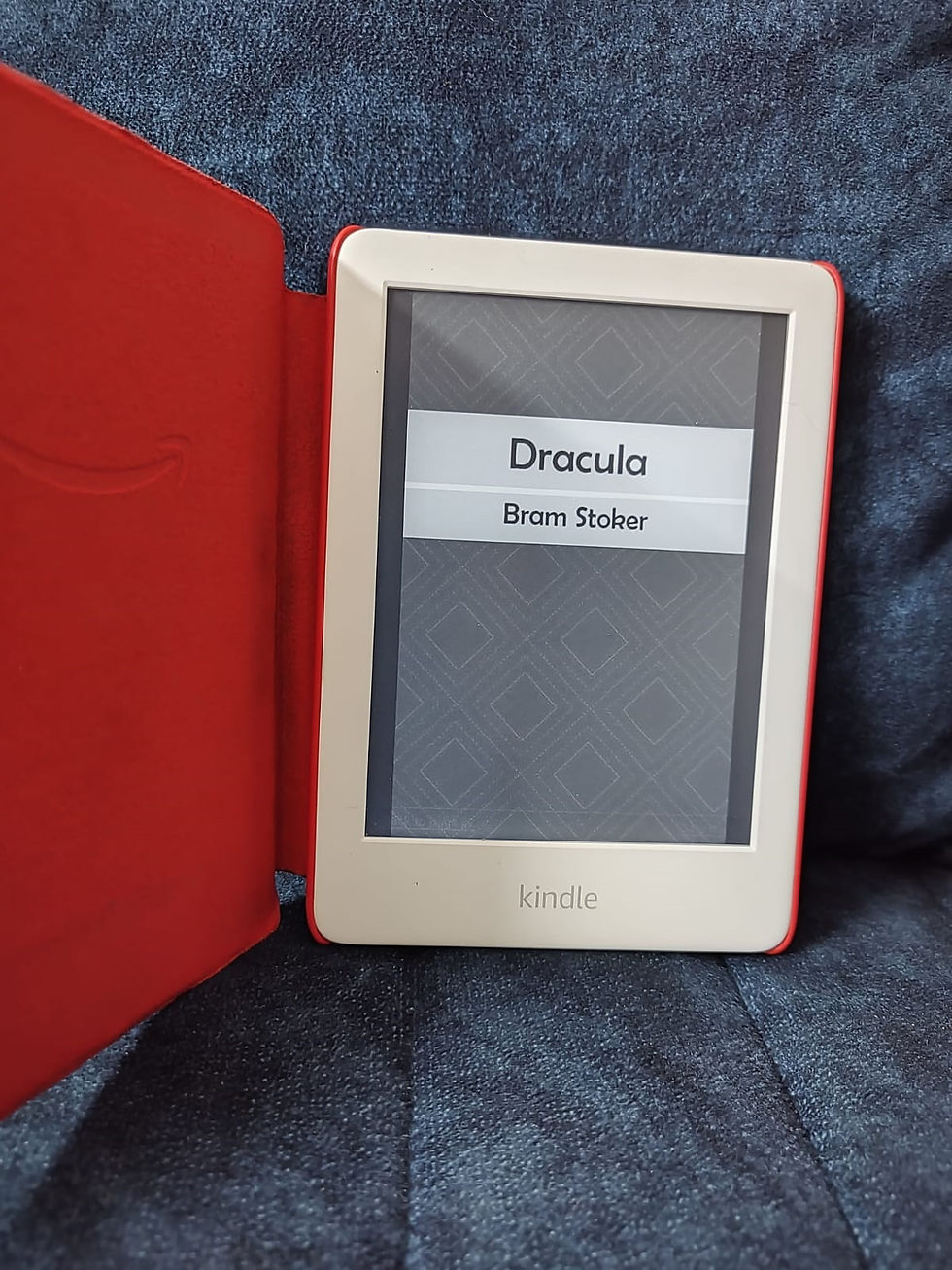
There are evenings when one feels like wandering into a different kind of world. It may be a quiet evening, with a book waiting to be opened and the familiar sounds of home in the background. On one such evening, I found myself studying about a book, Dracula, the famous Gothic horror novel by Bram Stoker, first published in 1897.
It was an unusual choice for me. My reading often takes me towards spirituality, faith and the quieter mysteries of life. This time, however, I was preparing to enter a world of dark castles, moonlit nights and creatures who belong more to legend than to ordinary experience. Curiosity won and I began reading.
Bram Stoker, an Irish novelist who lived from 1847 to 1912, gave the world one of its most enduring literary figures: Count Dracula. Although vampire legends existed long before the novel appeared, Stoker's creation helped shape the image of the vampire that generations of readers would come to recognize.
The story begins with Jonathan Harker, a young English solicitor who travels to Transylvania to meet Count Dracula regarding a property purchase in England. The Count lives in a lonely castle surrounded by mountains and dark forests. It is the sort of place where a traveller might wish he had stayed at the village inn for another night.
As mentioned in the book, at first, Dracula appears to be a courteous nobleman. But there is something unsettling about him. He has no reflection in a mirror, possesses extraordinary strength and keeps strange hours. Jonathan soon discovers that he is not a guest but a prisoner. The castle holds secrets and its master is no ordinary man.
Before long, Jonathan realises that Count Dracula is a vampire. His journey, which began as a simple business assignment, becomes a desperate struggle for survival.
The Count eventually travels to England aboard a ship. When the vessel reaches Whitby, a seaside town, its arrival is accompanied by tragedy. The crew have disappeared or died and the mysterious passenger has brought a new terror to English shores.
Among those who suffer from Dracula's presence is Lucy Westenra, a young woman whose unexplained illness puzzles her friends and doctors. Dr John Seward seeks the help of Professor Abraham Van Helsing, a physician whose knowledge extends beyond conventional medicine. Van Helsing begins to suspect that Lucy's condition has a supernatural explanation.
Despite their efforts, Lucy dies, but the horror does not end there. Jonathan Harker, his wife Mina, Van Helsing and their companions must eventually unite to confront Dracula and prevent him from spreading his evil further.
One of the pleasures of reading Dracula is the way Stoker tells his story. Rather than giving us a single narrator, he uses letters, diary entries and newspaper reports. The reader gradually pieces together the mystery, much as one might gather clues while listening to different people recount an extraordinary event.
There is a wonderful sense of atmosphere throughout the novel. The lonely castle, the restless sea, the shadowy nights and the fear of something unseen give the story its lasting power. Even ordinary places seem changed when the supernatural enters them.
Dracula himself is a memorable creation. He represents the fear of the unknown but the novel is also about courage, friendship and the determination of ordinary people to face an extraordinary danger.
For me, reading this book was a pleasant departure from my usual literary interests. Spirituality often encourages us to look for meaning in the unseen, while horror fiction asks us to imagine what might be hiding in the shadows. The two are very different journeys, yet both remind us of the enduring human fascination with mystery, life and death.
More than a century after its publication, Dracula remains an important work of Gothic horror. It is a book for those who enjoy suspense, supernatural tales and the atmosphere of an older world, when a dark forest or an unfamiliar traveller could still set the imagination racing.
I would recommend it to anyone wishing to explore the origins of the modern vampire in literature. And perhaps it is best read on a quiet evening, when the wind is stirring outside and the house has grown still. One may finish a chapter, close the book and look towards the window just a little more carefully than before.
After all, a good story does not always need to frighten us out of our wits. Sometimes, it merely leaves us wondering what might be waiting beyond the light of the lamp.
Great experience of reading the novel.
I am thankful to Amazon Kindle for giving me the opportunity to read this remarkable book. On a scale of 10 stars, I would give this book a rating of 9.
Thank you for visiting Majumdar Book Reviews.
Disclaimer: These are my personal thoughts, impressions and reflections based on my reading of the book. Your interpretation, views and opinions may differ from mine and that is perfectly natural. Books often become meaningful precisely because they allow different readers to see the same story through different eyes. If you believe that any factual aspect of this article should be reconsidered or re-examined, please feel free to share your views. We are all human and we can all make mistakes.
Thank you for reading.
For more reviews and recommendations, please visit my Book Review and Recommendation website:
Writer:
Mainak Majumdar
Book Critic


Comments