


Ruskin Bond’s Memoir: 'The Hill of Enchantment' : Book Review


Ruskin Bond’s Memoir: 'The Hill of Enchantment' : Book Review
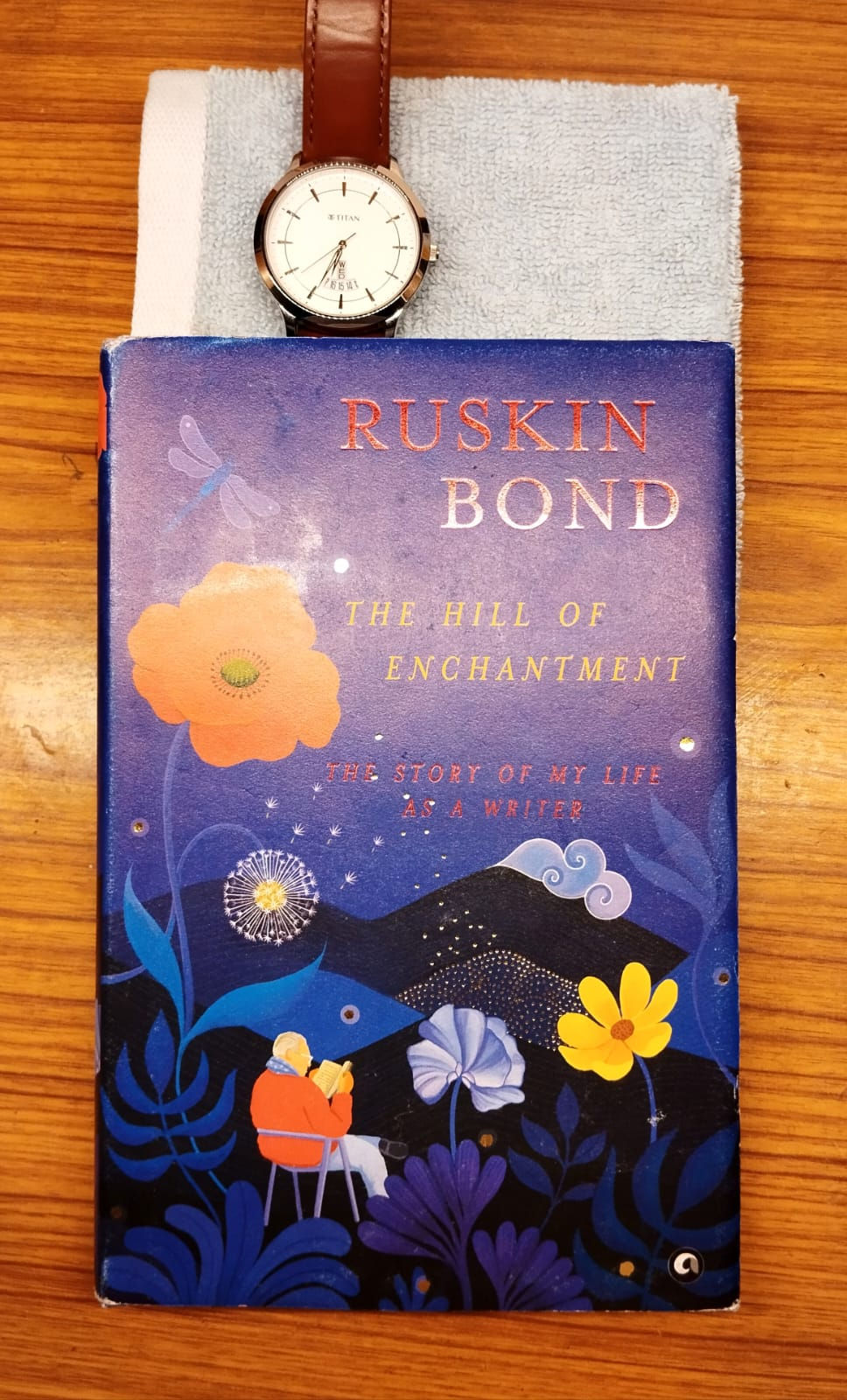
My recent journey through the pages of The Hill of Enchantment: ‘The Story of My Life as a Writer’ by Ruskin Bond felt less like reading a memoir and more like walking through a quiet, winding path in the hills—one that slowly reveals the meaning of life in whispers rather than declarations.
There are writers who impress you with their achievements and then there are those rare souls who invite you into their world so gently that you forget the weight of their greatness. Ruskin Bond belongs to the latter. Decorated with honours from the Government of India—the Padma Shri (1999), the Padma Bhushan (2014) and the Sahitya Akademi Fellowship (2021), he carries his accolades lightly, like fallen leaves that enrich the soil but never overshadow the tree. In his writing, you do not meet the celebrated author; you meet a companion who walks beside you through misty roads, rustling trees and forgotten afternoons.
When I read Ruskin Bond books, I begin to question myself about the complexity we so often attach to life. Is life truly as jumbled as we believe or have we simply moved too far away from its simplest truths? I feel that Bond seems to suggest that happiness is not something to be chased, it is something to be noticed amongst nature and amongst everything which surrounds you. This happiness may reside in the distant call of a cuckoo, in the quiet murmur of a stream finding its way through stones, in the sight of snow resting gently upon mountains and in a cup of tea held close against the chill of a hillside evening. These are not grand moments, yet they carry a completeness that modern life often denies us.
His memoir begins not with triumph, but with memory—with a return to the 1940s, to a world that feels both distant and strangely familiar. There is something deeply human in the way he recalls the leaking fountain pens of that era and his fondness for the old quill pens of his school days. It is not merely about writing instruments; it is about a time when creation was slower, more intimate and perhaps more honest.
As a young boy in New Delhi during the early 1940s, Bond often found himself alone in a quiet flat while his father, who worked long hours. Yet, this solitude was not empty—it was filled with imagination, with books and with the silent companionship of the world around him. His nearest neighbours, an elderly landlord and his wife, lived at the far end of the bungalow, like distant characters in a story unfolding gently.
There is an emotional beauty in the way he describes loneliness—not as something to be feared, but as something that shapes the soul. When his father was home, the old gramophone became a cherished friend. His memories of the old gramophone are so clear you can almost hear the music playing. It shows how sometimes, familiar objects and the memories attached to them offer just as much companionship as actual people.
Through his reflections, one begins to see a world that has quietly faded—a world where people knew each other not through screens, but through shared time and presence. Bond writes of Dehradun in 1955, a small town of “souls” rather than merely “people.” It speaks of a time when individuals were seen, felt and understood—not hurried past. Friendship had depth because time allowed it to breathe.
I feel that In contrast, our present world often feels crowded yet strangely empty. We communicate instantly, yet rarely connect. Bond does not criticize this change outright; instead, he gently holds up a mirror, allowing us to see what has been lost.
There are chapters of hardship too—moments that remind us that even the most serene lives carry their share of struggle. At a particular age, his years in Dehradun without electricity, living in rooms where even basic comforts were absent, reflect a life far removed from ease. Yet, there is no bitterness in his words. Instead, there is acceptance, as if he understood that discomfort too has its place in shaping a life of meaning.
At twenty-three, his time in Rajouri Garden at New Delhi, working with CARE and later his return to Mussoorie, mark the beginning of a journey defined not by certainty but by faith. Choosing to become a freelance writer is never an easy path and Bond’s life is a testament to patience. The small cottage he rented, the modest rent, the quiet years of writing—these were not stepping stones to instant success, but a long, steady journey.
In those years, he wrote stories that would one day become beloved—The Blue Umbrella, Angry River, Panther’s Moon. Yet, success did not arrive overnight. It took him thirty years to truly find his place in the hearts of readers. And perhaps that is what makes his journey so profound—it is not a story of sudden triumph, but of constant work.
He once wrote that he had to “worm his way into the hearts and minds of readers.” There is humility in that sentence, but also a quiet truth. Real connection is never forced; it is earned, slowly and sincerely.
And then, as the memoir draws to a close, there is Prem—a presence that feels deeply personal. Prem’s struggle for life adds a layer of emotional depth that lingers long after the pages are turned. It's a nice reminder that every writer is deeply influenced by the people they care about, in ways that are often hard to explain on paper.
As the memoir comes to a close, you're left picturing the faint green lights of Fairy Hill. It's a beautiful ending image that perfectly captures what Bond's life seems to be all about: just quietly watching the world and finding the stories hidden in it.
Reading Bond is less about the narrative and more about slowing down. He has a gentle way of reminding us to pay attention to the little things, proving that life doesn't actually need to be so complicated.
Perhaps, like the hills he writes about, life is meant to be walked slowly—one step, one breath, one moment at a time.
If I were to rate 'The Hill of Enchantment', written by Ruskin Bond, I would give it 9 out of 10.
Please note: These are my personal thoughts based on reading this book. Your views, facts and opinions may differ. Feel free to comment if you believe any facts in this article should be reconsidered or re-examined. We all are humans and we can make mistakes.
Thank you for visiting the Book Review and Book Recommendation website: https://majumdarbookreviews.asia
Thanks and regards,
Mainak Majumdar
Book Critic


Comments