


Book Review: 'O Dharmaputri!'

Some books inform, while others awaken.
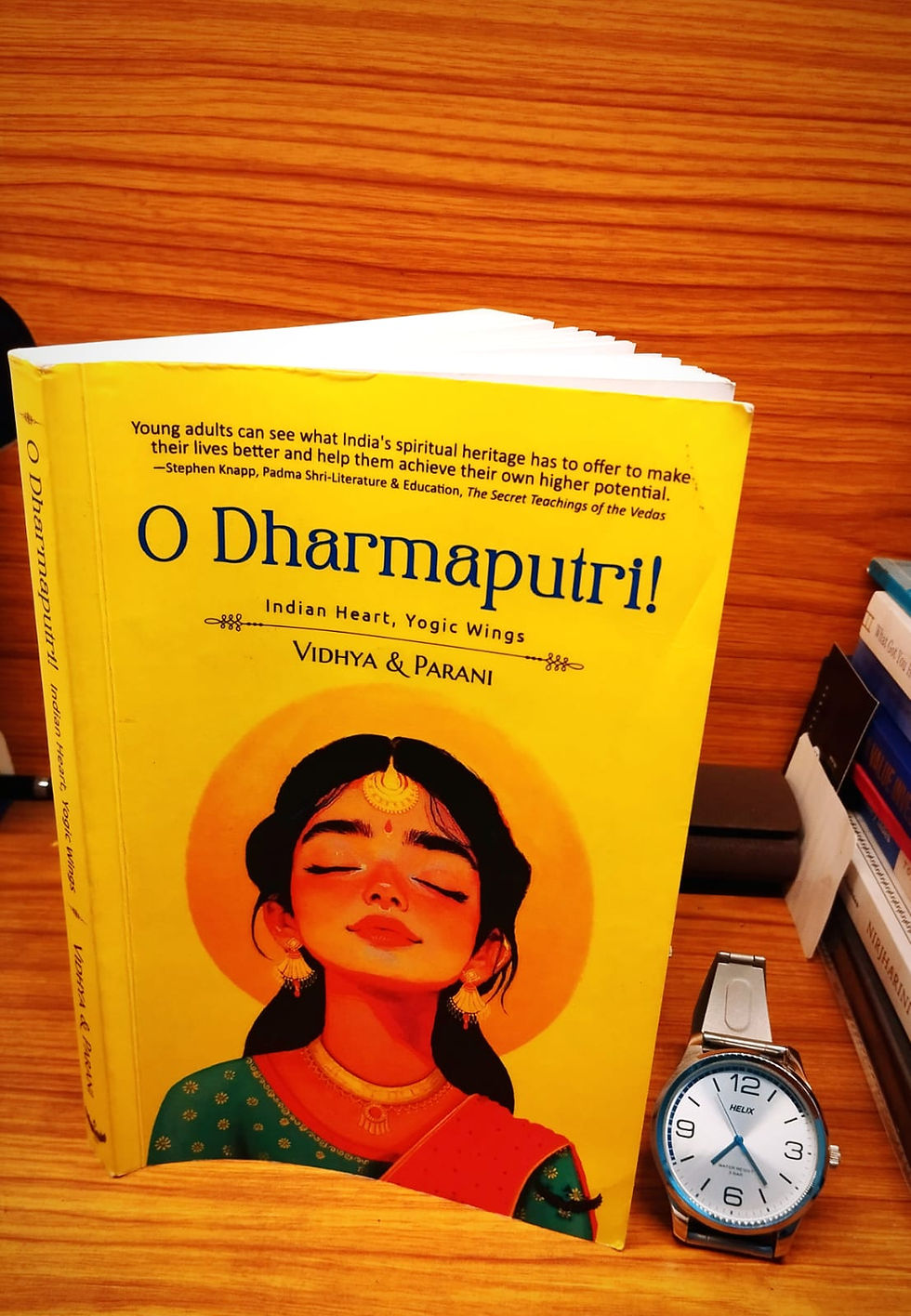
'O Dharmaputri ! – Indian Heart, Yogic Wings' falls into the second category. It doesn’t just tell a story; it shares a feeling. It seems less like a book and more like a letter sent across oceans, from the warm soil of India to the breezy shores of Cyprus. It is written by parents whose hearts are grounded in dharma and their words flow like a prayer. The authors now reside in Cyprus and shares their thoughts in the form of a letter addressed to their daughter, from an island country.
Living far from home in India, teaches both separation and belonging. Perhaps this distance emphasizes the authors’ clear insights. The daughter in this book leaves from home and in that journey begins her wisdom. This book send a message how Yoga and Vedanta philosophy can be easily applied to life today. Humans all over the world, will be able to understand how India's spiritual heritage offers solutions, to make their lives better and help them achieve dharma and discipline.
The story unfolds as a letter to a young daughter, Uma leaving home and is a vital moment when childhood ends; education and responsibility begins. This book is just not a parental advice; they serve as reflections, prompting readers to ask: What is your dharma? What treasure do you seek? The authors describe yoga not just as physical poses but as a union; dharma is not about strict rules but about following one's true calling.
Throughout the book, there is a subtle reminder of the priceless nature of freedom. In a touching section about India's struggle for independence, the authors express to their daughter that the freedom she enjoys today, were achieved through the sacrifices of previous generations. They also recounted an event where their grandmother was named "Sarada Mani" after Ma Sarada Devi, the spiritual partner of Sri Ramakrishna. This name goes beyond family history, becoming a symbol of heritage and a reminder of the unseen forces shaping the present.
As parents with a heritage of freedom fighters and now as global citizens, they have passed down their ancestors' teachings from childhood stories to discussions at home.
The narrative is revealed through a letter addressed to a young daughter, marking a pivotal moment where childhood ends and responsibility starts. The book offer more than just a parental advice. They invite the reader to reflect: What is your purpose? What treasure do you seek?
The book vividly recalls the memories of Kumbakonam and Mayiladuthurai, offering more than just a geographical journey but also a journey through memories. The authors draw attention to the era when colonial taxation severely impacted families and weakened India's once-prosperous economy. They emphasize that a nation, much like a child, is born into certain conditions and must navigate various challenges to grow.
In this manner, personal experiences intertwine with history, giving it a spiritual dimension. The challenges faced by a family, mirror the difficulties of a nation. However, the tone remains contemplative, not resentful. It implies that history can transform suffering into wisdom, provided we are open to learning.
A major strength of the book is its approachability. The language is simple, almost conversational. The reader does not feel burdened by philosophical jargon. Instead, profound ideas arrive gently, like a breeze through an open window. The authors weave quotations from sacred Indian texts into everyday anecdotes — dinner-table conversations and shared memories. This grounding of lofty ideals in ordinary life makes the teachings feel attainable rather than abstract.
However I feel from a critical perspective, the book's devotional tone occasionally diminishes its analytical sharpness. Although it passionately supports dharmic values and yogic discipline, it may have explored more deeply the conflicts that young people encounter in a globalized world. Perhaps that is also its quiet strength.
The book does not claim to solve every dilemma. It simply offers a compass. And as many spiritual journeys remind us, a compass is enough. The path must be walked by the seeker.
Ultimately the book, 'O Dharmaputri' is not just addressed to one daughter. It speaks to every reader standing at the edge of departure — from home, from comfort, from certainty. It reminds us that wherever we go — whether to distant islands or distant dreams , we carry within us an Indian heart and the wings of yoga that allow us to rise.
For in the end, the treasure we seek in the world is often the wisdom we carry within.
As mentioned in the book, the author Vidhya, a certified Sivananda Yoga teacher and Parani, who was once a ship captain, now navigates maritime investments.
If I were to rate 'O Dharmaputri !', written by Vidhya & Parani, I would give it 9 out of 10.
Please note: These are my personal thoughts based on reading this book. Your views, facts and opinions may differ. Feel free to comment if you believe any facts in this article should be reconsidered or re-examined. We all are humans and we can make mistakes.
Thank you for visiting the Book Review and Book Recommendation website: https://majumdarbookreviews.asia
Thanks and regards,
Mainak Majumdar
Book Critic



Comments